
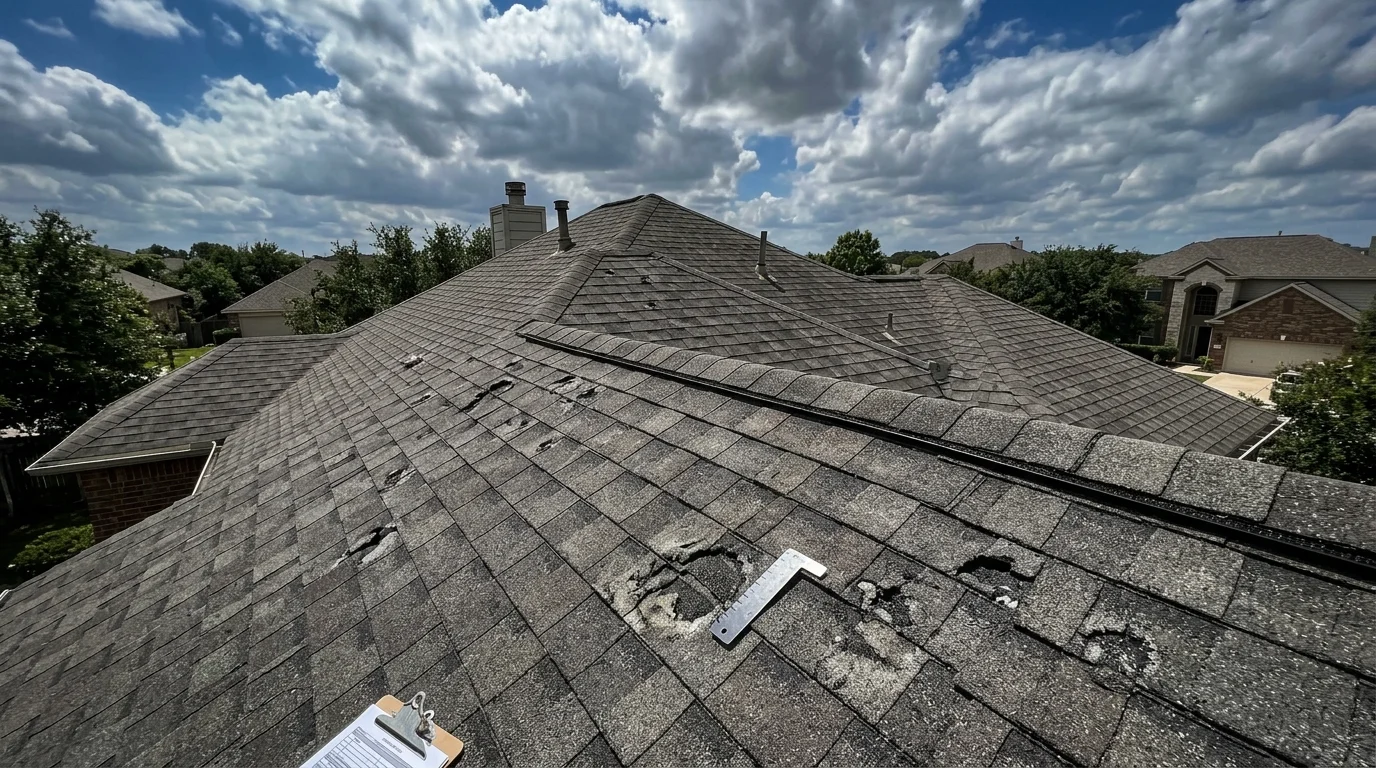
After a spring squall line tears across Alvin, Pearland, or League City, the worst thing a homeowner can assume is that "no ceiling drip means no roof damage." Along the upper Texas Gulf Coast, water leaks inside your drywall are usually the final stage of storm failure—often showing up 8 to 24 months after the fiberglass mat underneath your shingles was fractured.
1. Why Severe Hail Damage Stays Invisible From the Driveway
An architectural asphalt shingle isn’t a rigid tile; it is a layered sandwich of mineral ceramic granules on top, weathering asphalt in the middle, and a thin woven fiberglass mat providing structural tensile strength underneath. When 1-inch to 1.75-inch hailstones strike a sloped roof at 45 to 60 MPH, they don’t cut clean holes. Instead, they drive granules deep into the asphalt or knock them clean away while bending the fiberglass backing past its breaking point.
From the ground, those quarter-sized bruises blend into normal textured shadow lines. Up on the deck—and inside your 95°F+ Gulf Coast summer heat—that exposed black bitumen oxidizes, cracks, and slowly weeps rain straight into the OSB decking below.
2. Seven Safe Ground-Level Storm Clues You Can Check Today
Before calling your insurance carrier—or talking to a door-knocking storm chaser—walk your yard and check these seven telltale indicators:
- Downspout & Splash-Block Granule Piles: Fresh black or dark gray "coffee grounds" piled at gutter elbows indicate sudden impact dislodgement.
- Spatter Marks on Oxidized Fences or Brick: Clean circular dots on weathered wood fences, AC condenser fins, or painted patio furniture reveal both hail diameter and wind direction.
- Dented Mailbox Caps, Downspouts & Meter Boxes: Soft aluminum and thin-gauge galvanized steel record clear dings that prove hail energy reached ground elevation.
- Missing or Displaced Ridge Caps: Hip and ridge caps sit higher in laminar wind streams and tear loose first during 55–75 MPH Gulf gusts.
- Dark Horizontal Wind Creases: When a gust breaks the tar-strip seal and folds a shingle tab backward, it leaves a dark horizontal bruise right below the overlapping course—even if the tab lays flat afterward.
- Bent Aluminum Box Vents or Lead Pipe Boots: Looking up with binoculars, dented turbine blades or dimpled turtle vents are the single clearest preview adjusters check first.
- Neighborhood Activity Pattern: If two or three houses with similar roof orientations on your street are tarped or getting adjusted, your slope absorbed the exact same hail shaft.
3. Inside the Adjuster Inspection: What "Functional Damage" Means
Insurance carriers like TWIA and private Texas underwriters do not pay for cosmetic granule wear; they evaluate functional damage—impacts that shorten a shingle’s water-shedding lifespan. During a roof walk, an SSB Roofing storm specialist checks three elements per 10’×10’ test square (a 100 sq ft box chalked on North, South, East, and West directional slopes):
- Softness / Mat Fracture: Pressing gently with a thumb over an impact point reveals spongy "give" where the fiberglass scrim shattered underneath.
- Sharp Granule Embedment or Displacement: Granules knocked clean off or crushed sideways expose raw shiny asphalt around the perimeter of the impact crater.
- Collateral Soft-Metal Corroboration: Chalking soft aluminum furnace caps, chimney shrouds, and gutters confirms storm date and directional vector.
4. Distinguishing True Storm Damage From Blistering & Normal Aging
Honesty matters. Many "storm chasers" knock on doors in Friendswood or Clear Lake and circle normal heat blisters as "hail hits," setting homeowners up for an automatic denial and an unwanted claim inquiry on their Clue report. Thermal blisters erupt outward from trapped attic moisture and poor ventilation (look like popped volcanos with raised lips), whereas hail strikes hammer inward from above.
At SSB Roofing, if your roof shows only non-storm blistering or isolated pipe-boot rot, Jeremiah shows you the photos directly and quotes a straightforward targeted repair—we never tell homeowners to file a bogus claim.
5. How Test Squares Determine Repair vs. Full Replacement
In Texas insurance claims, adjusters typically inspect a 10’×10’ test square on every directional slope. When 7 to 10+ legitimate hail hits (or directional wind-torn tabs that fail a gentle brittleness test) appear on multiple slopes, carriers generally approve full replacement rather than patchy spot repairs that cannot tie cleanly into older brittle shingles.
When slope damage meets replacement thresholds in coastal catastrophe counties (Brazoria, Galveston, and East Harris), your scope also needs full TDI WPI-8 windstorm code compliance, ring-shank deck re-nailing where exposed, and drip-edge/ice-and-water valley upgrades.
6. Safe Post-Storm Action Plan
Save this 4-step sequence whenever a hailstorm or hurricane feeder band sweeps through your ZIP code:
- Save ground photos of any hailstones next to a coin/ruler and soft-metal spatter with date timestamps.
- If water is actively dripping indoors, schedule emergency tarping right away—insurance policies require homeowners to mitigate ongoing interior damage.
- Request an independent, zero-cost before opening a formal claim so you know your exact roof condition first.
- If storm thresholds are met, have SSB Roofing meet your adjuster on-roof to walk every elevation, soft-metal hit, and Texas building code item side by side.