
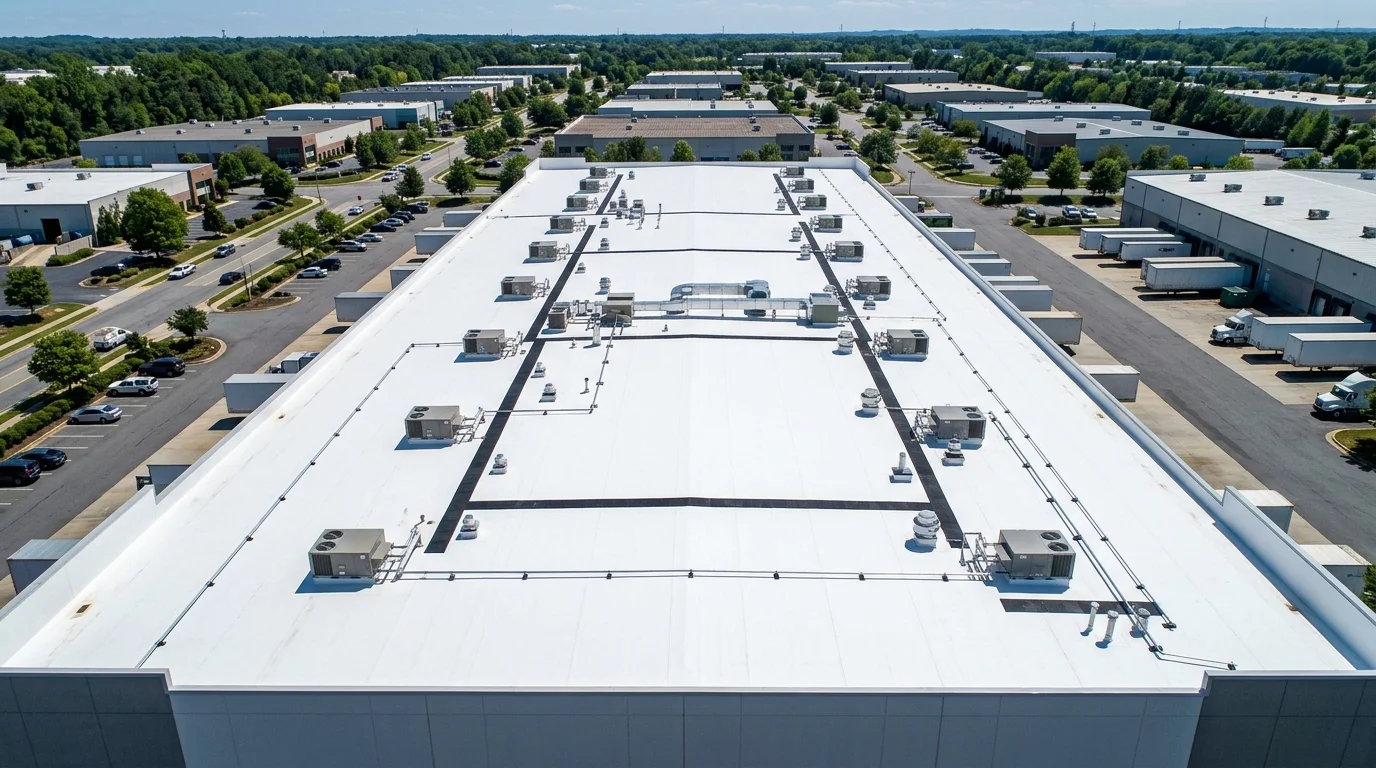
Property owners and facility managers across Greater Houston, Alvin, League City, and Clear Lake routinely get handed six-figure bids for complete commercial tear-offs the moment an aged TPO, EPDM, modified bitumen, or metal standing-seam roof begins weeping at RTU curbs or fasteners. Before approving landfill tear-off costs, look closely at whether 75%+ of your existing substrate is still dry and sound.
1. Why Gulf Coast Commercial Roofs Fail Early at Seams & Penetrations
On retail strip centers, churches, warehouses, and Houston Apartment Association (HAA) multifamily buildings, membrane degradation rarely starts in the flat field. Instead, blistering solar cycles cause sheet metal pitch pans, HVAC curbs, heat-welded seams, and exposed metal screw heads to pull apart—creating capillary leaks while leaving most insulation dry underneath. Meanwhile, flat decks frequently trap pockets of ponding water after 5-inch Gulf downpours.
2. Fluid-Applied 100% High-Solids Silicone: Seamless & Ponding-Proof
Instead of tearing off structurally intact roofing and opening active tenant suites to Houston summer storms, commercial high-solids silicone restoration turns your old substrate into the new structural base:
- Moisture Diagnostic & Spot Wet-Out Replacement: We isolate and cut out any localized saturated insulation areas first so zero moisture is ever trapped beneath the coating.
- 4,000 PSI Commercial Wash & Priming: Removes chalking, grease around exhaust vents, and oxidation.
- Fabric Seam & Curb Armor: Every seam, skylight curb, scupper, and fastener head receives butter-grade flashing sealant embedded with reinforcement mesh.
- 20–30+ Mil Monolithic Silicone Topcoat: Sprayed or rolled into a single seamless, inorganic rubber skin with no seams to ever split and zero degradation under standing ponding water.
3. When Full TPO or Metal Overlay Is the Right Engineering Call
Honest engineering cuts both ways. Silicone coating is not a magic fix for a neglected roof whose insulation board is waterlogged like a sponge. We recommend a mechanical recover or full tear-off TPO/PVC/metal replacement whenever:
- More than 25%–30% of sub-membrane polyiso or wood-fiber insulation tests wet via core cuts / infrared scan.
- Structural metal decking has rusted through from chronic chemical exhaust or long-term leaks.
- Multiple existing roofs (2+ layers) already exist and municipal building codes prohibit recovering without tear-off.
4. Real-World 10,000 Sq Ft Comparison & 88% UV Cooling Impact
Use our interactive Commercial Silicone ROI Calculator to plug in your square footage, or compare typical Texas benchmarks on a 10,000 sq ft flat roof:
- Full TPO / Mod-Bit Tear-Off & Re-Roof: Typically ~$85,000–$110,000+ depending on taper, curbs, and crane mobilization—plus dumpsters blocking parking stalls.
- High-Solids Silicone Restoration: Roughly ~48% lower capital expenditure (often ~$38,000–$52,000), renewable every 15–20 years with a light recoat without ever tearing off the roof again.
- HVAC Electricity Savings: Bright white high-reflectivity silicone reflects roughly 88% of solar UV load, dropping roof surface temps by up to 50°F–60°F and easing chiller demand on top-floor units.
5. Zero Operational Disruption & Potential Section 179 Advantages
No screaming tear-off saws, zero falling debris hazards over storefront entrances, and solvent-free low-VOC application options keep restaurants, clinics, offices, and multifamily residents completely undisturbed. Plus, qualifying commercial roof restoration and HVAC improvements often qualify for favorable maintenance classification or federal Section 179 depreciation rules (check with your CPA).